Nutrition of French Fries Nutrition Facts Baby Back Pork Ribs
 | |
| Alternative names | Chips, finger fries, fries, frites, hot chips, steak fries, slap fries |
|---|---|
| Course | Side dish or snack, rarely equally a main dish |
| Identify of origin | Belgium or France (disputed) |
| Region or state | Western Europe |
| Serving temperature | Hot |
| Main ingredients |
|
| Variations | Curly fries, shoestring fries, steak fries, sweet potato fries, chili cheese fries, poutine |
| Other information | Often served with salt and a side of ketchup, mayonnaise, vinegar, barbecue sauce, or other sauce |
| |
 Cookbook: French fries
 Media: French fries
French chips (North American English), chips (British English),[1] finger chips (Indian English),[2] french-fried potatoes, or simply fries, are batonnet or allumette-cut[iii] deep-fried potatoes, originating from either Belgium or French republic. They are prepared by cutting the white potato into even strips, so drying and frying it, commonly in a deep fryer. Most french fries are produced from frozen russet potatoes.
French fries are served hot, either soft or crispy, and are generally eaten equally part of lunch or dinner or by themselves as a snack, and they commonly appear on the menus of diners, fast food restaurants, pubs, and bars. They are often salted and may be served with ketchup, vinegar, mayonnaise, love apple sauce, or other local specialities. Fries can exist topped more heavily, equally in the dishes of poutine or chili cheese fries. Chips can be made from sweetness potatoes instead of potatoes. A baked variant, oven chips, uses less or no oil.[4]
Preparation

Pommes frites with a mayonnaise packet

A hamburger with crispy fries
The standard method for cooking french fries is deep frying, which submerges them in hot fat, nowadays virtually commonly oil.[five] Vacuum fryers produce potato chips with lower oil content, while maintaining their colour and texture.[half dozen]
The potatoes are prepared by first cutting them (peeled or unpeeled) into even strips, which are so wiped off or soaked in cold h2o to remove the surface starch, and thoroughly dried.[vii] [8] They may then be fried in one or ii stages. Chefs generally agree that the two-bath technique produces improve results.[7] [9] [10] Potatoes fresh out of the basis can have also high a water content—resulting in soggy chips—and so preference is for those that have been stored for a while.[xi]
In the two-phase or two-bath method, the kickoff bath, sometimes called blanching, is in hot fat (around 160 °C/320 °F) to cook them through. This step can be done in accelerate.[vii] Then they are more briefly fried in very hot fat (190 °C/375 °F) to crisp the outside. They are and so placed in a colander or on a cloth to drain, salted, and served. The exact times of the two baths depend on the size of the potatoes. For example, for 2–iii mm strips, the first bathroom takes about three minutes, and the second bath takes just seconds.[7]
Since the 1960s, nigh french fries have been produced from frozen potatoes which take been blanched or at to the lowest degree air-dried industrially.[12] Starting in the 1960s, more fast nutrient restaurants have been using frozen french chips.[11] Most chains that sell fresh cut chips apply the Idaho Russet Burbank variety of potatoes. It has been the standard for french fries in the United states.[11] The usual fatty for making french fries is vegetable oil. In the past, beef suet was recommended equally superior,[vii] with vegetable shortening every bit an alternative. In fact, McDonald'due south used a mixture of 93% beef tallow and 7% cottonseed oil until 1990, when they switched to vegetable oil with beef flavouring.[13] [14]
Chemical and concrete changes
French fries are fried in a two-stride process: the kickoff time is to cook the starch throughout the entire cut at low heat, and the 2nd time is to create the golden crispy exterior of the fry at a college temperature. This is necessary because if the potato cuts are only fried once, the temperature would either exist as well hot, causing only the outside to be cooked and not the inside, or non hot plenty where the entire fry is cooked, simply its crispy outside volition non develop. Although the potato cuts may exist broiled or steamed every bit a training method, this department will merely focus on french fries made using frying oil. During the initial frying process (approximately 150 °C), h2o on the surface of the cuts evaporates off the surface and the h2o inside the cuts gets absorbed by the starch granules, causing them to keen and produce the fluffy interior of the fry.[xv]
The starch granules are able to retain the water and expand due to gelatinisation. The h2o and heat interruption the glycosidic linkages between amylopectin and amylose strands, assuasive a new gel matrix to form via hydrogen bonds which aid in water retention. The wet that gets trapped in between the gel matrix is responsible for the fluffy interior of the fry. The gelatinised starch molecules move towards the surface of the fries "forming a thick layer of gelatinised starch" and this layer of pre-gelatinised starch will turn into the crispy exterior after the murphy cuts are fried for a 2nd time.[16] During the second frying process (approximately 180 °C), the remaining water on the surface of the cuts volition evaporate and the gelatinised starch molecules that collected towards the potato surface are cooked once again, forming the crispy exterior. The golden-brown colour of the fry volition develop when the amino acids and glucose on the outside participate in a Maillard browning reaction.[15]
Etymology
In the Usa and most of Canada, the term french fries, sometimes capitalised as French chips, or shortened to chips, refers to all dishes of fried elongated pieces of potatoes. Variants in shape and size may have names such equally curly chips, shoestring fries, etc.[17] In the United Kingdom, Australia, South Africa, Ireland and New Zealand, the term chips is by and large used instead, though thinly cut fried potatoes are sometimes called french fries or skinny fries, to distinguish them from fries, which are cut thicker. In the U.s.a. or Canada these more thickly-cut fries might be chosen steak fries, depending on the shape. The word fries is more oft used in Northward America to refer to potato chips, known in the Britain and Republic of ireland as crisps.[18]
Thomas Jefferson had "potatoes served in the French manner" at a White House dinner in 1802.[19] [20] The expression "french fried potatoes" first occurred in print in English in the 1856 work Cookery for Maids of All Work by Eastward. Warren: "French Fried Potatoes. – Cut new potatoes in thin slices, put them in humid fat, and a little salt; fry both sides of a light golden brown colour; drain."[21] This business relationship referred to thin, shallow-fried slices of potato (french cut) – it is not clear where or when the now familiar deep-fried batons or fingers of potato were commencement prepared. In the early 20th century, the term "french fried" was being used in the sense of "deep-fried" for foods like onion rings or chicken.[22] [23]
Origin

The French and Belgians take an ongoing dispute most where fries were invented, with both countries claiming buying.[24] From the Belgian standpoint, the popularity of the term "french fries" is explained every bit "French gastronomic hegemony" into which the cuisine of Belgium was assimilated because of a lack of understanding coupled with a shared language and geographic proximity of the countries.[24] Fries may have been invented in Spain, the offset European country in which the potato appeared from the New Globe colonies.[25] Professor Paul Ilegems, curator of the Frietmuseum in Bruges, Belgium, believes that Saint Teresa of Ávila of Kingdom of spain cooked the offset french chips, and refers as well to the tradition of frying in Mediterranean cuisine as prove.[26] [27]

The Belgian journalist Jo Gérard claimed that a 1781 family unit manuscript recounts that potatoes were deep-fried prior to 1680 in the Meuse valley, in what was and then the Spanish Netherlands (present-day Belgium): "The inhabitants of Namur, Andenne, and Dinant had the custom of fishing in the Meuse for small-scale fish and frying, especially amongst the poor, but when the river was frozen and fishing became hazardous, they cutting potatoes in the course of pocket-sized fish and put them in a fryer like those here."[28] [26] Gérard has not produced the manuscript that supports this claim. In whatever example, it is unrelated to the later history of the french fry, as the murphy did not get in in the region until around 1735. Also, given 18th-century economic conditions: "Information technology is absolutely unthinkable that a peasant could take dedicated large quantities of fat for cooking potatoes. At most they were sautéed in a pan".[29]
Ane story nearly the name "french fries" claims that when the American Expeditionary Forces arrived in Belgium during Earth War I, they assumed that chips were a French dish because French was spoken in the Belgian Regular army.[thirty] [28] Merely the name existed long before that in English, and the popularity of the term did non increase for decades after 1917.[31] At that time, the term "french chips" was growing in popularity – the term was already used in the United States equally early equally 1899 – although it isn't clear whether this referred to batons (chips) or slices of potato eastward.chiliad. in an item in Good Housekeeping which specifically references "Kitchen Economic system in France": "The perfection of French fries is due chiefly to the fact that enough of fat is used".[32]
Global use
"Pommes frites" or just "frites" (French), "frieten" (a word used in Flanders and the southern provinces of holland) or "patat" (used in the north and cardinal parts of the Netherlands) became the national snack and a substantial role of several national dishes, such as Moules-frites or Steak-frites.[33] Fries are very popular in Belgium, where they are known as frieten (in Dutch) or frites (in French), and the Netherlands, where among the working classes they are known equally patat in the north and, in the south, friet(en).[34] In Belgium, chips are sold in shops called friteries (French), frietkot/frituur (Belgian Dutch), snackbar (Dutch in The Netherlands) or Fritüre/Frittüre (German language). They are served with a big diverseness of Belgian sauces and eaten either on their own or with other snacks. Traditionally fries are served in a cornet de frites (French), patatzak [35] /frietzak/fritzak (Dutch/Flemish), or Frittentüte (German language), a white paper-thin cone, so wrapped in paper, with a spoonful of sauce (often mayonnaise) on top.
In France and other French-speaking countries, fried potatoes are formally pommes de terre frites, simply more usually pommes frites, patates frites, or simply frites. The words aiguillettes ("needle-ettes") or allumettes ("matchsticks") are used when the french fries are very small and thin. 1 enduring origin story holds that french chips were invented past street vendors on the Pont Neuf bridge in Paris in 1789, just before the outbreak of the French Revolution.[36] However, a reference exists in France from 1775 to "a few pieces of fried potato" and to "fried potatoes".[37] Eating potatoes for sustenance was promoted in France by Antoine-Augustin Parmentier, but he did not mention fried potatoes in item. A note in a manuscript in U.S. president Thomas Jefferson's hand (circa 1801–1809) mentions "Pommes de terre frites à cru, en petites tranches" ("Potatoes deep-fried while raw, in modest slices"). The recipe almost certainly comes from his French chef, Honoré Julien.[19]
The thick-cutting fries are called pommes Pont-Neuf [vii] or but pommes frites (about x mm); thinner variants are pommes allumettes (matchstick potatoes; well-nigh 7 mm), and pommes paille (white potato straws; 3–4 mm). (Roughly 0.4, 0.3 and 0.fifteen inch respectively.) Pommes gaufrettes are waffle fries. A popular dish in French republic is steak frites, which is steak accompanied past sparse french fries.

French fries migrated to the High german-speaking countries during the 19th century. In Germany, they are usually known by the French words pommes frites , or only Pommes or Fritten (derived from the French words, but pronounced every bit German language words).[38] Ofttimes served with ketchup or mayonnaise, they are popular as a side dish in restaurants, or as a street-nutrient snack purchased at an Imbissstand (snack stand). Since the 1950s, currywurst has become a widely-popular dish that is commonly offered with fries. Currywurst is a sausage (often bratwurst or bockwurst) in a spiced ketchup-based sauce, dusted with curry pulverisation.[39]
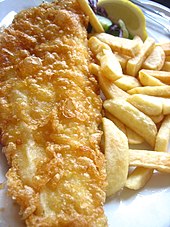
The standard deep-fried cut potatoes in the United Kingdom are called chips, and are cutting into pieces between 10 and 15 mm (0.39 and 0.59 in) wide. They are occasionally made from unpeeled potatoes (skins showing). British chips are not the same matter every bit tater chips (an American term); those are chosen "crisps" in Britain. In the United kingdom, fries are part of the popular, and now international, fast food dish fish and chips. In the Uk, chips are considered a split particular to french fries. Chips are a thicker cut than french fries, they are generally cooked only once and at a lower temperature.[40] [41] [42] From 1813 on, recipes for deep-fried cut potatoes occur in popular cookbooks.[43] Past the tardily 1850s, at to the lowest degree one cookbook refers to "French Fried Potatoes".[44] The start commercially bachelor chips in the United kingdom of great britain and northern ireland were sold by Mrs. 'Granny' Duce in one of the West Riding towns in 1854.[45] A blue plaque in Oldham marks the origin of the fish-and-chip shop, and thus the starting time of the fast food manufacture in United kingdom of great britain and northern ireland.[46] In Scotland, chips were outset sold in Dundee: "in the 1870s, that celebrity of British gastronomy – the scrap – was first sold by Belgian immigrant Edward De Gernier in the city's Greenmarket".[47] In Ireland the first chip shop was "opened by Giuseppe Cervi", an Italian immigrant, "who arrived there in the 1880s".[48] It is estimated that in the UK, fourscore% of households buy frozen chips each year.[49] Although french chips were a popular dish in virtually British Commonwealth countries, the "thin way" french fries have been popularised worldwide in large part past the large American fast nutrient bondage such as McDonald'southward, Burger Male monarch, and Wendy's.[50] In the United States, the J. R. Simplot Visitor is credited with successfully commercializing french fries in frozen form during the 1940s. After, in 1967, Ray Kroc of McDonald's contracted the Simplot company to supply them with frozen fries, replacing fresh-cut potatoes. In 2004, 29% of the United States' potato crop was used to make frozen fries – 90% consumed by the food services sector and ten% past retail.[51] The U.s. is besides known for supplying China with near of their french chips as 70% of Prc'southward french fries are imported.[52] [53] Pre-fabricated french chips have been bachelor for home cooking since the 1960s, having been pre-fried (or sometimes baked), frozen and placed in a sealed plastic pocketbook.[54] Some fast-food bondage dip the chips in a sugar solution or a starch batter, to change the appearance or texture.[55] French fries are ane of the most popular dishes in the United states of america, commonly being served as a side dish to entrees and beingness seen in fast food restaurants. The average American eats around 30 pounds of french fries a year.[56]

The town of Florenceville-Bristol, New Brunswick in Canada, headquarters of McCain Foods, calls itself "the French fry upper-case letter of the world" and likewise hosts a museum about potatoes called Potato World.[57] McCain Foods is the globe's largest manufacturer of frozen french chips and other potato specialities.[58] French fries are the main ingredient in the Canadian/Québécois dish known as poutine, a dish consisting of fried potatoes covered with cheese curds and brown gravy. Poutine has a growing number of variations, simply it is by and large considered to have been developed in rural Québec erstwhile in the 1950s, although precisely where in the province information technology first appeared is a matter of contention.[59] [threescore] [61] Canada is besides responsible for providing 22% of China's french chips.[62] [53]
In Kingdom of spain, fried potatoes are called patatas fritas or papas fritas. Some other common class, involving larger irregular cuts, is patatas bravas. The potatoes are cut into big chunks, partially boiled and then fried. They are normally seasoned with a spicy love apple sauce.[63] Fries are a mutual side dish in Latin American cuisine or role of larger preparations similar the salchipapas in Peru or chorrillana in Chile.[64] [65] Whilst eating 'regular' crispy french fries is common in South Africa, a regional favourite, particularly in Greatcoat Boondocks, is a soft soggy version doused in white vinegar called "slap-chips" (pronounced "slup-chips" in English language or "slaptjips" in Afrikaans).[66] [67] [68] These fries are typically thicker and fried at a lower temperature for a longer period of time than regular french fries.[66] Slap-chips are an important component of a Gatsby sandwich, likewise a mutual Cape Boondocks delicacy.[66] Slap-fries are too commonly served with deep fried fish which are also served with the same white vinegar. Fried potato ( フライドポテト , Furaido poteto ) is a standard fast nutrient side dish in Japan.[69] Inspired by Japanese cuisine, okonomiyaki fries are served with a topping of unagi sauce, mayonnaise, katsuobushi, nori seasoning (furikake) and stir-fried cabbage.[70]
Variants
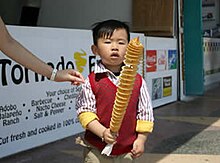
A child holding tornado fries
French fries come in multiple variations and toppings. Some examples include:
- Carne asada fries – chips covered with carne asada, guacamole, sour foam and cheese.[71]
- Cheese chips – fries covered with cheese.[72]
- Chili cheese chips – chips covered with chili and cheese.[73]
- Cockle-cutting fries – too known equally "wavy fries", these are cut in a corrugated, ridged style.[17]
- Curly fries – characterised by their helical shape, cut from whole potatoes using a specialised screw slicer.[17]
- Back-scratch chips – fries covered in curry sauce.[74]
- Dirty chips – fries covered in melted cheese with diverse toppings such equally bacon, pulled pork, chili or gravy.[75]
- French fry sandwich[76] – such as the chip butty, horseshoe sandwich and the mitraillette.
- Kimchi chips – chips topped with caramelised baechu-kimchi and greenish onions[77] [78] [79]
- Oven fries – fries that are cooked in the oven as a final step in the training.[80]
- Tater wedges – thick-cut, elongated wedge-shaped fries with the skin left on.[17]
- Poutine – a dish consisting of fries topped with cheese curds and gravy and principally associated with the Canadian province of Québec.[81]
- Shoestring fries – thin-cut chips.[17]
- Steak chips – thick-cut fries.[17]
- Sweet irish potato fries – fries fabricated with sweetness potatoes instead of traditional white potatoes.[82]
- Tornado fries – spiral-cut potatoes that are placed on a skewer and then deep fried.[17]
- Triple-cooked fries – fries that are simmered, cooled and drained using a depression-temp-long-time (LTLT) cooking technique; they are then deep fried at just 130 °C, cooled and finally deep fried at 180 °C.[83]
- Waffle fries – lattice-shaped chips obtained past quarter-turning the murphy before each next slide over a grater and deep-frying but once.[17]
-

Chili fries
-

-

Cockle-cut fries
-

-

Curry chips
-
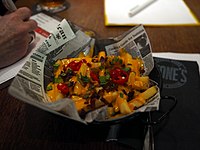
Dirty fries
-

Shoestring fries with blue cheese dressing
-

Sweet potato fries
-

Waffle chips
Accompaniments
Fries tend to be served with a diverseness of accompaniments, such equally common salt and vinegar (malt, balsamic or white), pepper, Cajun seasoning, grated cheese, melted cheese, mushy peas, heated back-scratch sauce, curry ketchup, hot sauce, relish, mustard, mayonnaise, bearnaise sauce, tartar sauce, chili, tzatziki, feta cheese, garlic sauce, fry sauce, butter, sour cream, ranch dressing, barbecue sauce, gravy, love, aioli, brown sauce, ketchup, lemon juice, piccalilli, pickled cucumber, pickled gherkins, pickled onions or pickled eggs.[84] In Australia, a popular flavouring added to chips is chicken table salt.
Nutrition


French fries primarily incorporate carbohydrates (mostly in the form of starch) and protein from the white potato, and fat captivated during the deep-frying process. Salt, which contains sodium, is almost always applied every bit a surface seasoning. For example, a large serving of french fries at McDonald's in the United states is 154 grams and includes 350 mg of sodium. The 510 calories come from 66 g of carbohydrates, 24 g of fat and vii g of protein.[85]
A number of experts have criticised french chips for beingness very unhealthy. According to Jonathan Bonnet in a Time magazine article, "chips are nutritionally unrecognisable from a spud" because they "involve frying, salting, and removing one of the healthiest parts of the potato: the skin, where many of the nutrients and fiber are found."[86] Kristin Kirkpatrick calls french fries "an extremely starchy vegetable dipped in a fryer that and so loads on the unhealthy fat, and what you have left is a nutrient that has no nutritional redeeming value in it at all."[86] David Katz states that "French chips are often the super-fat side dish to a burger—and both are ofttimes used every bit vehicles for things like sugar-laced ketchup and fatty mayo."[86] Eric Morrissette, spokesperson for Health Canada, states that people should limit their intake of french chips, simply eating them occasionally is non likely to be a wellness concern.[86]
Frying french fries in beef tallow, lard, or other fauna fats adds saturated fat to the diet. Replacing creature fats with tropical vegetable oils, such as palm oil, simply substitutes 1 saturated fat for another. For many years partially hydrogenated vegetable oils were used as a means of avoiding cholesterol and reducing saturated fat acid content, but in time the trans fat content of these oils was perceived equally contributing to cardiovascular affliction.[87] Starting in 2008, many restaurant chains and manufacturers of pre-cooked frozen french fries for abode reheating phased out trans fat containing vegetable oils.[88] [89]
French fries contain some of the highest levels of acrylamides of whatever foodstuff, and experts have raised concerns about the effects of acrylamides on human wellness.[ninety] [91] According to the American Cancer Social club, it is non articulate as of 2013[update] whether acrylamide consumption affects people'due south risk of getting cancer.[ninety] A meta-analysis indicated that dietary acrylamide is not related to the risk of near mutual cancers, but could not exclude a modest clan for kidney, endometrial or ovarian cancers.[91] A lower-fat method for producing a french fry-like product is to glaze "frenched" or wedge potatoes in oil and spices/flavouring before blistering them. The temperature volition be lower compared to deep frying, which reduces acrylamide formation.[92]
Legal issues
In June 2004, the United States Department of Agronomics (USDA), with the advisement of a federal district judge from Beaumont, Texas, classified concoction-coated french fries as a vegetable under the Perishable Agricultural Commodities Human activity. This was primarily for trade reasons; french chips do not meet the standard to be listed as a processed nutrient.[93] [94] This classification, referred to as the "French fry rule", was upheld in the United States Court of Appeals for the 5th Circuit case Fleming Companies, Inc. v. USDA.[95] [96]
Encounter also
- Avocado fries
- Freedom chips
- French fry vending machine
- German fries
- List of deep fried foods
- Mitraillette
- Pommes dauphine
- Pommes duchesse
- Pommes soufflées
Citations
- ^ "flake: definition of flake in Oxford lexicon (British English)". Oxforddictionaries.com. 12 September 2013. Retrieved 16 September 2013.
- ^ Indian English language, "finger chip". Cambridge Dictionary Online.
- ^ Taihua Mu, Hongnan Sun, Xingli Liu, Potato Staple Nutrient Processing Engineering science, p. 14, Springer, 2016 ISBN 9811028338.
- ^ "Chunky oven chips". BBC Proficient Food. BBC. Retrieved 7 March 2016.
- ^ Amber, Fariha (17 Baronial 2021). "Top tips for making the perfect chips". The Daily Star . Retrieved 17 August 2021.
- ^ Garayo, Jagoba; Moreira, Rosana (i November 2002). "Vacuum frying of murphy fries". Journal of Food Engineering. 55 (two): 181–191. doi:10.1016/S0260-8774(02)00062-6. ISSN 0260-8774.
- ^ a b c d e f Saint-Ange, Evelyn and Aratow, Paul (translator) (2005) [1927]. La Bonne Cuisine de Madame E. Saint-Ange: The Essential Companion for Authentic French Cooking. Larousse, translation Ten Speed Press. p. 553. ISBN978-i-58008-605-9. CS1 maint: multiple names: authors list (link)
- ^ Fannie Farmer, The Boston Cooking-Schoolhouse Cook Book, 1896, south.v.
- ^ Blumenthal, Heston (17 April 2012). "How to cook perfect spuds". The Age . Retrieved 12 October 2012.
- ^ Bocuse, Paul (10 December 1998). La Cuisine du marché (in French). Paris: Flammarion. ISBN978-2-08-202518-8.
- ^ a b c "Russet Burbank". idahopotato.com. Retrieved ix Jan 2018.
- ^ "The Making of French Fries". thespruce.com. Retrieved 8 December 2017.
- ^ Schlosser, Eric (2001). Fast Food Nation: The Dark Side of All-American Repast. Houghton Mifflin. ISBN 0-395-97789-4
- ^ Grace, Francie (5 June 2002). "McDonald's Settles Beef Over Fries". CBS News. Archived from the original on 29 July 2012. Retrieved 4 May 2011.
- ^ a b Mal, Julie (26 Oct 2019). "Science of making perfect fries". Food Crumbles.
- ^ Kaushik, Nitisha (11 July 2019). "Ultimate Guide to Crispy French Fries". The Countertop Cook.
- ^ a b c d e f g h Lingle, B. (2016). Chips!: An Illustrated Guide to the World'south Favorite Nutrient. Chronicle Books. pp. 50–53. ISBN978-i-61689-504-4 . Retrieved i July 2017.
- ^ "Chips, chips or crisps? Netizens debate over names given to dissimilar types of potato chips". The Indian Express. 5 September 2018. Retrieved 17 August 2021.
- ^ a b Ebeling, Charles (31 October 2005). "French fried: From Monticello to the Moon, A Social, Political and Cultural Appreciation of the French Fry". The Chicago Literary Guild. Archived from the original on iii February 2007. Retrieved 12 January 2007.
- ^ Fishwick, Marshall West (1998). "The Savant equally Gourmet". The Journal of Popular Culture. 32 (part 1): 51–58. doi:x.1111/j.0022-3840.1998.3201_51.x.
- ^ Home: Oxford English Dictionary. Oed.com. Retrieved 12 September 2012.
- ^ Mackenzie, Catherine (7 April 1935). "Nutrient the Urban center Likes Best". The New York Times Magazine: SM18. Retrieved 15 April 2007.
the chef at the Rainbow Room launches into a description of his special steak, its French-fried onion rings, its button mushrooms
- ^ Rorer, Sarah Tyson (c. 1902). "Page 211". Mrs. Rorer's New Cook Book. Philadelphia: Arnold & Company. p. 211. Retrieved 12 April 2007.
French Fried Chicken
- ^ a b Schehr, Lawrence R.; Weiss, Allen S. (2001). French Food: On the Table On the Page and in French Civilization. Abingdon: Routledge. p. 158. ISBN978-0415936286.
- ^ Rupp, Rebecca (8 January 2015). "Are French Fries Truly French?". Civilisation . Retrieved 26 October 2021.
{{cite web}}: CS1 maint: url-status (link) - ^ a b Ilegems, Paul (1993). De Frietkotcultuur (in Dutch). Loempia. ISBN978-90-6771-325-ii.
- ^ Swalec, Andrea (28 July 2010). "In Belgium, frites aren't small-scale potatoes". Reuters . Retrieved 26 Oct 2021.
- ^ a b (in French) Hugues Henry (16 August 2001) "La Frite est-elle belge?" (in French). Archived from the original on 24 May 2013. Retrieved 3 March 2012. . Frites.be. Retrieved 12 September 2012.
- ^ Leclercq, Pierre (ii February 2010). La véritable histoire de la pomme de terre frite, musee-gourmandise.be, mentioning the work of Fernand Pirotte on the history of the potato
- ^ McDonald, George (2007). Frommer's Belgium, Holland & Luxembourg. Wiley Publishing. p. 485. ISBN978-0-470-06859-5.
- ^ Google ngrams for "French fried potatoes" and "French fries" in the US and Britain corpora [one]
- ^ Handy, Mrs. Moses P. "Kitchen Economy in French republic", Good Housekeeping, Volumes 28–29 159 Vol XXIX No 1 July 1899 Whole No 249. Retrieved 16 November 2014.
- ^ Schehr, Lawrence R.; Weiss, Allen S. (2001). French Food: On the Table On the Page and in French Civilisation. Abingdon: Routledge. pp. 158–159. ISBN978-0415936286.
- ^ See this map indicating where patat/friet/frieten is used in the Depression Countries
- ^ (in Dutch) Patatzak vouwen – Video – Allerhande – Albert Heijn. Ah.nl. Retrieved on xiii Nov 2016.
- ^ "La frite est-elle Belge ou Française ?". Le Monde (in French). 2 January 2013. Retrieved three February 2014.
- ^ Le Moyne Des Essarts, Nicolas-Toussaint (1775). Causes célebres curieuses et interessantes, de toutes les cours ..., Book 5, p. 41 and P. 159 . Retrieved sixteen November 2014.
- ^ "Erste Runde – Pommes frites", Atlas zur deutschen Alltagssprache (AdA), Phil.-Hist. Fakultät, Universität Augsburg, ten. November 2005
- ^ Currywurst – dice Erfindung: Nur ohne ist sie das Original Archived 28 April 2015 at the Wayback Automobile
- ^ Alan Davidson, The Oxford Companion to Food, p. 180, Oxford University Press, 2014 ISBN 0199677336.
- ^ Brian Yarvin, The Ploughman'south Luncheon and the Miser'south Banquet, p. 83, Houghton Mifflin Harcourt, 2012 ISBN 1558324135.
- ^ Mcalpine, Fraser. "Fries or chips? What is the Deviation Between French Fries and British Chips?". BBC America . Retrieved xvi July 2020.
- ^ Ude, Louis (1822) The French Melt. J. Ebers
- ^ Warren, Eliza (c. 1859). The Economical Cookery Book for Housewives, Cooks, and Maids-Of-All-Work, With Hints to the Mistress and Servant. London: Piper, Stephenson, and Spence. p. 88. OCLC 27869877.
French Fried Potatoes
- ^ Chaloner, W. H.; Henderson, Westward. O. (1990). Industry and Innovation: Selected Essays. Taylor & Francis ISBN 0714633356.
- ^ "Blue Plaques". world wide web.oldham.gov.uk . Retrieved nine May 2021.
John Lees – originator of fish and chips. Market place Hall, Albion Street, Oldham.
- ^ "Dundee Fact File". Dundee City Quango. Archived from the original on viii April 2007. Retrieved 20 March 2007.
- ^ "A postcard, Giuseppe Cervi and the story of the Dublin chipper". Come Here To Me!. xiv March 2017. Retrieved 15 March 2017.
- ^ "Top Chip Facts". Archived from the original on xi February 2011. Retrieved 11 February 2011.
{{cite web}}: CS1 maint: bot: original URL status unknown (link). Lovechips.co.great britain. 27 February 2011 - ^ "Popularization". today.com. Retrieved 3 January 2018.
- ^ "Frozen Irish potato Fries Situation and Outlook". Archived from the original on xv December 2013. Retrieved 12 September 2012.
- ^ "Prc'south US importation". Forbes . Retrieved 7 January 2018.
- ^ a b "Tater Imports to Mainland china Report". 5 October 2015. Retrieved seven Jan 2018.
- ^ "Pre-Made Fries". historyoffastfood.com. Retrieved 3 January 2018.
- ^ "The Trouble with Fries". The New Yorker. 25 Feb 2001. Retrieved 17 August 2021.
- ^ "Amount of French Fries". foxnews.com. 22 November 2016. Retrieved 4 Jan 2018.
- ^ N.B. museum celebrates the apprehensive white potato | The Chronicle Herald. Thechronicleherald.ca (xix September 2014). Retrieved on thirteen November 2016.
- ^ Stephenson, Amanda (14 June 2021). "French fry behemothic McCain Foods' environmental promises could change murphy farming in Alberta". Calgary Herald. Retrieved 25 October 2021.
- ^ Semenak, Susan (6 February 2015). "Backstage at La Banquise – because information technology's always poutine week there". Montreal Gazette.
- ^ Sekules, Kate (23 May 2007). "A Staple From Quebec, Embarrassing but Adored". The New York Times . Retrieved xix May 2008. Article on Poutine coming to New York City
- ^ Kane, Marion (eight November 2008). "The war of the curds". The Star . Retrieved 16 December 2001.
- ^ "Canada's Imports". frozenfoodsbiz.com. Archived from the original on 8 January 2018. Retrieved 7 Jan 2018.
- ^ "Patatas Bravas". spanish-food.org. Retrieved 12 November 2017.
- ^ Gregory, Vanessa (5 November 2009). "Tastes of Newly Fashionable Valparaíso, Chile". The New York Times. ISSN 0362-4331. Retrieved 17 August 2021.
- ^ Mishan, Ligaya (xviii July 2019). "Peruvian, Fortifying and Frank, at Warique in Queens". The New York Times. ISSN 0362-4331. Archived from the original on 2 January 2022. Retrieved 17 August 2021.
- ^ a b c "Slap Chips - a Greatcoat Town favourite". world wide web.capetownetc.com. 19 February 2018. Retrieved 28 August 2019.
- ^ "Top tips for making the perfect fries". Food24. 1 March 2016. Retrieved 28 Baronial 2019.
- ^ Dall, Nick (8 September 2017). "Why South Africans Go Mad for These Soggy Fries". OZY . Retrieved 28 August 2019.
- ^ "The best-tasting French fries in Japan are…". Japan Today. two September 2012.
- ^ "Okonomiyaki fries". Potatoes USA.
- ^ Allen Borgen (25 Dec 2008). "Stop at Picante and say, 'Fill 'er upwards!'". San Bernardino Sun. Archived from the original on 29 February 2012. Retrieved 22 Dec 2012.
Maria Desiderata Montana (18 September 2012). Nutrient Lovers' Guide to® San Diego: The Best Restaurants, Markets & Local Culinary Offerings. Rowman & Littlefield. p. 69. ISBN978-0-7627-8904-7. - ^ "5 to Try: Cheese fries". Commercial Appeal . Retrieved 3 Apr 2018.
- ^ Zorn, Marc (18 August 2014). "Who Invented Chili Cheese Fries - Vision Launch". Vision Launch . Retrieved 7 July 2017.
- ^ Walker, Kylie (12 Feb 2019). "Have you discovered the glory of curry chips?". SBS . Retrieved 17 August 2021.
{{cite web}}: CS1 maint: url-status (link) - ^ Kirwin, Ellen: Liverpool's all-time dirty fries, cheesy fries and downright filthy food, Liverpool Echo 8 March 2017. Accessed on 13 May 2021.
- ^ The U.Southward. Open is selling a delicious sandwich with french fries on it | For The Win. Ftw.usatoday.com (17 June 2016). Retrieved on 13 Nov 2016.
- ^ "Kimchi Fries".
- ^ "kimchi chips".
- ^ "How to Brand Kimchi Fries".
- ^ "Oven Fries Recipe". Cooking. The New York Times . Retrieved 17 August 2021.
- ^ "'Protect our poutine': Quebec dairy group looks to requite gooey dish official status". Saanich News. xix May 2021. Retrieved 17 August 2021.
- ^ Severson, Kim (25 Nov 2010). "Sweet Potatoes Footstep Out From Under Marshmallows". The New York Times. ISSN 0362-4331. Archived from the original on 2 Jan 2022. Retrieved 17 August 2021.
- ^ Dubecki, Larissa (26 July 2016). "The quest for the 'Perfect Fleck'". Good Food . Retrieved 17 August 2021.
- ^ List of accompaniments to french fries – Unlikely Words – A blog of Boston, Providence, and the world. Unlikely Words (7 November 2011). Retrieved 12 September 2012.
- ^ "McDonald's Nutrition Facts for Popular Card Items" (PDF). nutrition.mcdonalds.com. Archived from the original (PDF) on 21 October 2011.
- ^ a b c d "Fried Potatoes and Acrylamide: Are French Fries Bad For Yous?". Time. 11 June 2015. Retrieved 13 Nov 2016.
- ^ "Health Risks". Forbes . Retrieved 4 January 2018.
- ^ "McDonalds Trans fats". Reuters. 23 May 2008. Retrieved 4 January 2018.
- ^ "Burger King Trans fats". NBC News. Retrieved 4 Jan 2018.
- ^ a b "Acrylamide". American Cancer Society. i October 2013.
- ^ a b Pelucchi C, Bosetti C, Galeone C, La Vecchia C (2015). "Dietary acrylamide and cancer risk: an updated meta-analysis". Int. J. Cancer. 136 (12): 2912–22. doi:10.1002/ijc.29339. PMID 25403648. S2CID 26689375.
- ^ "Eat Fries—Guilt-Costless!". Prevention. three November 2011. Retrieved nineteen April 2016.
- ^ "Land of Origin Labelling: Frequently Asked Questions". Agricultural Marketing Service. 12 January 2009. Archived from the original on 3 February 2009.
- ^ Dreyfuss, Ira (16 June 2004). "Batter-Coated Frozen French Fries Called Fresh Vegetable". The Washington Post.
- ^ "Agronomical Marketing Agreement Act - vol63_at_958.pdf" (PDF). Archived from the original (PDF) on 15 Dec 2013. Retrieved 16 September 2013.
- ^ "04-40802: Fleming Companies 5. Dept of Agronomics :: 5th Circuit :: Us Court of Appeals Cases :: Justia". Law.justia.com. Retrieved 16 September 2013.
General bibliography
- Lingle, Blake (2016). Fries!: An Illustrated Guide to the World's Favorite Food. New York: Princeton Architectural Printing. ISBN9781616894580.
- Tebben, Maryann (2006). "French Fries: France's Culinary Identity from Brillat-Savarin to Barthes (essay)". Convivium Artium. University of Texas at San Antonio. Archived from the original on five May 2014. Retrieved 28 December 2009.
External links
Source: https://en.wikipedia.org/wiki/French_fries
0 Response to "Nutrition of French Fries Nutrition Facts Baby Back Pork Ribs"
Post a Comment